
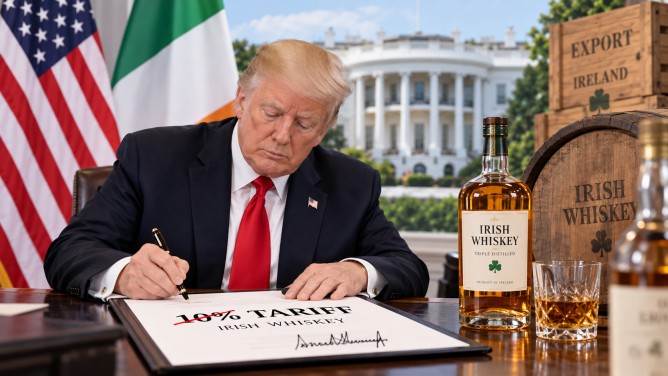
In a significant announcement that could help ease trade tensions between the United States and Ireland, President Donald Trump has decided to eliminate the 10% tariff on Irish whiskey imports. The announcement was made during a trophy ceremony at the Irish Open golf tournament held in Ireland, where Trump indicated that he had been repeatedly encouraged to make this change. This move is expected to positively impact both the trade relationship between Washington and Dublin and the American businesses involved in selling Irish whiskey.
The 10% tariff, which had been reduced from an initial 15% in July, was part of a broader set of duties imposed by the Trump administration on imports from the European Union. The Irish Whiskey Association had previously advocated for the removal of this tariff, emphasizing that such an action would benefit U.S. businesses and alleviate uncertainty for consumers who enjoy Irish whiskey. Trump’s decision follows a previous tariff exemption granted to UK whiskey, which covered products like Scotch whisky and Northern Ireland spirits.
While the decision marks a meaningful shift in US trade policy concerning European alcohol imports, details regarding the implementation of the new exemption for Irish whiskey have not yet been disclosed. The adjustment aligns with the broader trend of the Trump administration’s efforts to modify trade policies with European nations, reflecting a continuous reshaping of tariffs and trade agreements.
Industry stakeholders and policymakers alike are watching closely to see how this decision will play out in practical terms. The removal of the tariff could pave the way for increased imports of Irish whiskey into the U.S., potentially boosting sales and reducing costs for American distributors and consumers. As specifics of the exemption’s timeline remain pending, the move is anticipated to be welcomed by those in the trade sector who have long advocated for more favorable conditions for European imports.