
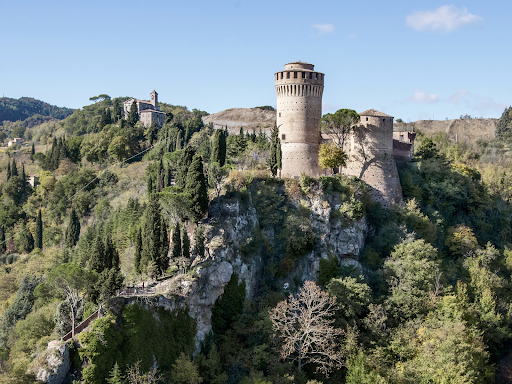
The small town of Venosa, tucked away in the Basilicata region, is a historical powerhouse that belies its current size. It offers a unique opportunity to trace multiple layers of history, from Roman antiquity to the medieval era, without the distraction of crowds.
Venosa holds fame as the birthplace of the illustrious Roman lyric poet, Horace. Its archaeological richness, however, is far broader, preserving significant and well-maintained Roman remains that testify to its long-standing importance in Southern Italy.
Adding to this historical diversity are the powerful and moving ancient Jewish catacombs, a rare remnant that highlights the multicultural depth of the region’s past. Crowning this historical landscape is a striking medieval castle, visually connecting these disparate eras.
The surrounding Basilicata countryside reinforces this theme of forgotten grandeur. Magnificent, yet uncelebrated, castles and palaces stand at nearby locations like Melfi, Lagopesole, and Pietragalla. These structures possess the scale to be world-famous, but their isolation preserves their quiet dignity.
This unhurried encounter with history stands in contrast to the quiet natural beauty found at Cividale del Friuli, with its Lombard treasures and emerald river. Both, however, are examples of an Italy that rewards the discerning traveler with solitude and depth.